
Outdoor Photovoltaic System Diagnostics: Why IR is the world's 95% mainstream and EL is only 5%?
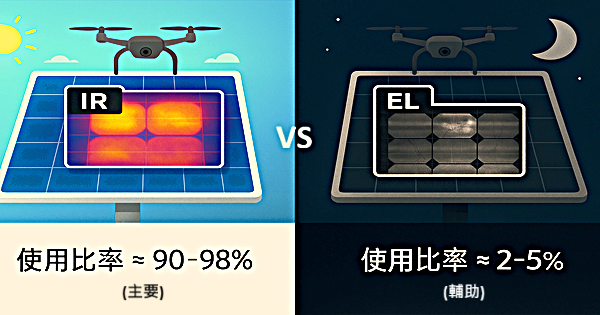
In the outdoor inspection process of photovoltaic (PV) systems, IR (Infrared Thermography) and EL (Electroluminescence) are key module diagnostic technologies. However, many people are still unclear about the differences between the two. Global surveys show that the usage rate of IR reaches as high as 90–98%, while EL accounts for only about 2–5%. This difference mainly arises from variations in operating conditions, inspection efficiency, cost, technical requirements, and their roles within international standards.
Operating Conditions
IR (Thermal Imaging) Usage Ratio ≈ 90 ~98%,
- Can be performed during the daytime without shutting down the system, resulting in no loss of power generation.
- When combined with drone platforms, large areas can be scanned quickly and safely.
- Capable of detecting most field defects, including hot spots, PID, diode failures, shading, string abnormalities, and wiring issues. It has become the mainstream tool for solar O&M worldwide.
- According to regional statistics, Europe and the United States are close to 100%; Japan: 95 ~98%; Taiwan: 90 ~95%.
EL (Electroluminescence) Usage Rate ≈ 2–5%,
- Must be performed at night or under low-light conditions.
- Requires wiring and current injection, which involves operational risks and is time-consuming.
- Outdoor inspection productivity is very low.
- The cost is approximately 10–30 times higher than IR.
- Mainly used for warranty disputes, accident investigations, COD sampling inspections, and detailed micro-crack analysis.
Efficiency Difference
Taking a 4 MW photovoltaic system as an example (based on literature data from IEA PVPS Task 13),
- IR (drone-based inspection): 5–10 hours (fastest).
- IR (handheld): 15–20 hours.
- EL (drone-based inspection): 20–40 hours.
- EL (ground-based): 100–150 hours (slowest).
- The labor time for EL is more than 4–10 times longer than IR, and the cost is also significantly higher.
Technical Requirements
- IR is suitable for routine inspections: fast, cost-effective, and capable of covering a wide range of defect types when combined with AI or expert analysis.
- EL is suitable for high-precision diagnostics, such as detecting micro-cracks and hidden cracks, and for providing image evidence in warranty disputes. However, its authority is still lower than laboratory-based single-module testing.
- For large-scale solar plants (10–100 MW), performing full EL inspections on all modules is generally neither economically viable nor operationally practical.
- IR = Mainstream tool for routine inspections; EL = A specialized tool for small-area detailed inspections, with higher operational requirements, typically used in warranty dispute cases.
Cost Comparison
- IR: 1× (daytime inspection, fast, and high coverage).
- EL: 10–30× (nighttime operation, wiring required, high labor input, and low productivity).
- For large-scale solar plants, choosing IR is almost the only practical option.
Key Differences
- According to international O&M standards, about 95% of defects can be quickly detected using IR, while EL is mainly used for detecting micro-cracks or resolving warranty disputes.
- IR is suitable for large-area thermal defect scanning, while EL is used only in limited cases for specific purposes.
- The high cost and low productivity of EL make it unsuitable to replace IR as a routine inspection tool.
International Standards
- IEC TS 62446-3:2017 — Photovoltaic systems – Thermal imaging: Defines the formal standard procedure for thermal imaging inspections of outdoor photovoltaic systems.
- IEA PVPS Task 13 — Review on Infrared and Electroluminescence Imaging for PV Field Applications: Indicates that IR is suitable for rapid large-area scanning, while EL requires low-light conditions and has higher operational requirements.
- C. Buerhop et al., IEA PVPS Report (2020): Compares IR and EL in terms of efficiency, application limitations, and image quality differences in outdoor field use.
- Recent EL Field Studies (2024–2025): Indicate that outdoor EL inspections are costly, have low productivity, and require specialized personnel, making full-scale commercial inspections difficult to implement.
Overall Conclusion
- IR accounts for approximately 95% of outdoor inspection activities, offering high efficiency, strong cost-effectiveness, and the ability to cover most major defects.
- EL accounts for approximately 5% as an auxiliary diagnostic tool, mainly used for high-precision analysis and situations requiring legal evidence.
- International PV O&M standards consistently adopt the approach of “IR as the primary method and EL as a supplementary tool,” positioning EL for project-specific applications rather than routine inspection practices.