
Key Summary of International Standards for Thermal Imaging Inspection of Photovoltaic Systems
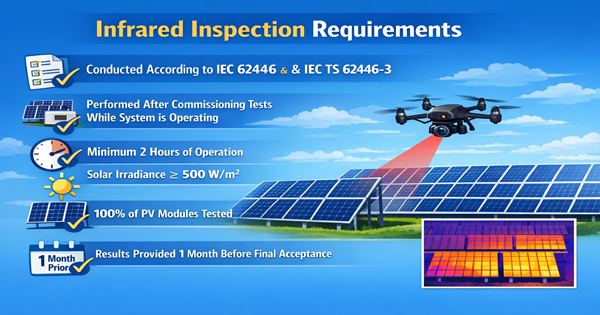
Inspection Objectives
• Identify temperature anomalies that cannot be explained by normal operation or system design
• The focus is on identifying potential defects rather than merely measuring temperature
Inspection Conditions
• The system shall be in operation during inspection
• The system shall reach a stable state
• Avoid significant fluctuations in irradiance and load
Environmental Requirements
• Irradiance ≥ 500 W/m²
• Wind speed ≤ approximately 4 m/s
• Cloud cover ≤ 2/8
• Modules should be kept clean
Scope of Inspection
• 100% of PV modules
• Electrical equipment (cabling, combiner boxes, inverters, etc.)
Image Acquisition Requirements
• IR images should be captured as perpendicular to the module surface as possible
• Avoid reflections and angular errors
• UAVs or ground-based thermal cameras may be used
Analysis Methodology
• Calculate the mean temperature of the region
• More accurate than single-point measurements
Temperature Difference Evaluation (ΔT)
• Use the temperature difference between the module and its surroundings as the evaluation criterion
• Environmental and load conditions shall be taken into account
Anomaly classification
• Hot spot
• Module anomaly
• Overheating at electrical connections
• String anomaly
Trend Analysis
• Use ΔT for long-term comparison
• Used for degradation monitoring and fault prediction
Inspection Report Requirements
• Personnel and equipment information
• Inspection date, time, and location
• Environmental conditions (irradiance, temperature, wind speed, cloud cover)
• Locations of anomalies and corresponding thermal images
• Defect classification and maintenance recommendations
Personnel Qualifications
• Personnel shall possess knowledge of electrical systems and PV systems
• Possess the ability to interpret thermal images
Conclusion
IEC TS 62446-3 emphasizes that inspections shall be conducted under stable operating conditions, utilizing area-based temperature analysis and temperature differential (ΔT) evaluation to ensure comprehensive assessment, engineering reliability, and international consistency of the results.